Osama Rabie, Chairman of the Suez Canal Authority, explained that joint consultations with shipping lines and positive feedback from many clients, indicating a return to stability in the Red Sea region, have led some shipping lines to change their routes to use the Suez Canal rather than the Cape of Good Hope.
Since the beginning of February, 47 ships have altered their routes to transit the Suez Canal instead of navigating via the Cape of Good Hope, according to a statement issued by the Suez Canal Authority.
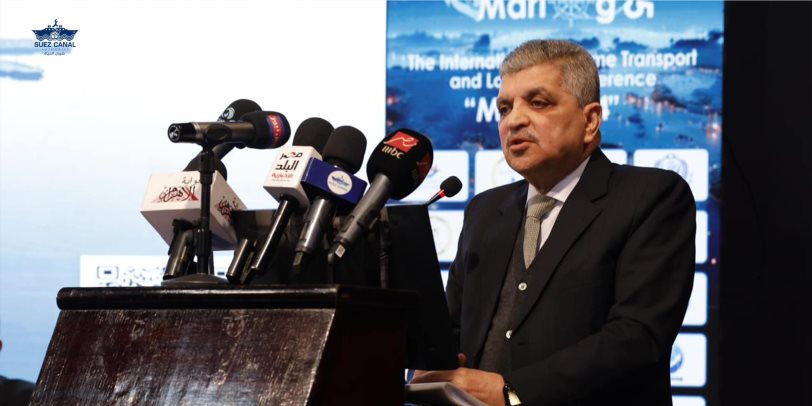
Osama Rabie, Chairman of the Suez Canal Authority, explained that joint consultations with shipping lines and positive feedback from many clients, indicating a return to stability in the Red Sea region, have led some shipping lines to change their routes to use the Suez Canal rather than the Cape of Good Hope.
He expects that more shipping lines will revert to the canal as long as regional stability continues.
This announcement was made during Rabie’s participation in the opening of the 14th Annual International Maritime and Logistics Conference (MARLOG).
The Chairman also outlined the Authority’s efforts to reduce the crisis’s impact on its clients, which include maintaining continuous, effective, and direct communication with shipping lines, stabilizing pricing policies, and launching a comprehensive package of maritime and logistics services.
These services cover vessel maintenance and repair, maritime rescue, pollution control, marine first aid, crew changes, and refueling.
Rabie emphasized that these challenges have not hindered the Suez Canal Authority from pursuing its ambitious development plans. The Authority remains focused on maintaining the canal’s readiness and enhancing the quality of services provided to its clients.
He noted that the Suez Canal has achieved a new milestone in infrastructure and navigational channel development by completing and operationalizing the two-phase southern sector development project.
This project offers several navigational advantages, including increased safety margins, reduced impact of water currents on transiting vessels, and an enhanced capacity to handle an additional 6–8 ships.
Moreover, the Authority continues its efforts to localize the construction of various marine units within its fleets and affiliated companies. It recently announced the establishment of the first factory for building floating concrete pontoons at the Canal Ports Company—one of its subsidiaries.
This facility will be a significant milestone, as it will be the first specialized plant in Egypt and Africa for constructing pontoons needed for yacht marinas and moorings for small vessels, at a cost that is up to 60 percent lower than the cost of importing them.