IMF chief Kristalina Georgieva reaffirmed strong support for Egypt during talks with President El-Sisi in Kenya.
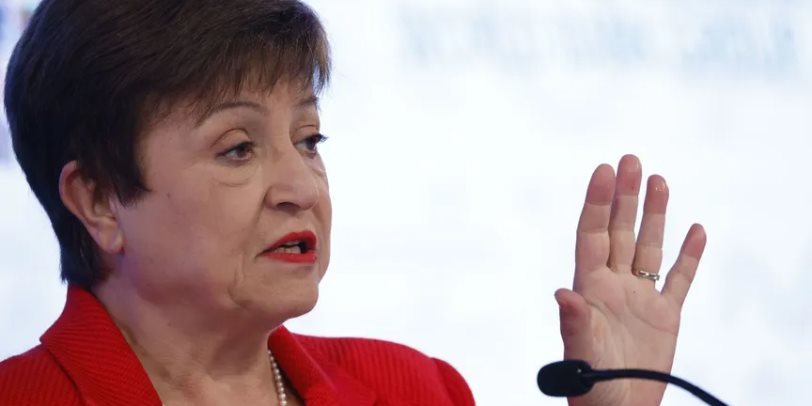 IMF chief Kristalina Georgieva reaffirmed the Fund’s “strong support” for Egypt
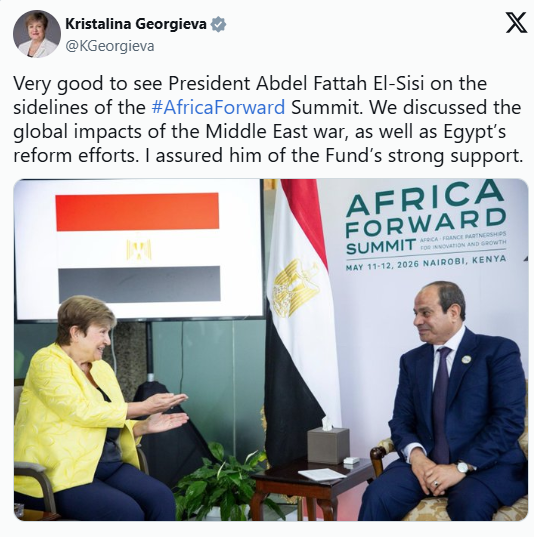
IMF Managing Director Kristalina Georgieva reaffirmed the Fund’s strong support for Egypt during talks with President Abdel Fattah El-Sisi on the sidelines of the “Africa Forward” summit in Kenya, as discussions focused on regional economic pressures and Egypt’s reform program.
Kristalina Georgieva reaffirmed the International Monetary Fund’s strong support for Egypt during a meeting with Egyptian President Abdel Fattah El-Sisi on the sidelines of the “Africa Forward” summit in Kenya.
In a post on X, Georgieva said discussions with President El-Sisi focused on the global economic repercussions of the Iran war, as well as Egypt’s ongoing economic reform efforts.
“I reiterated the Fund’s strong support for Egypt,” Georgieva wrote.
The meeting comes as the IMF continues to view Egypt’s economic reforms, particularly exchange rate flexibility and efforts to strengthen foreign reserves and financial buffers, as key factors that helped the country absorb part of the economic shocks triggered by the regional conflict.
Earlier, Jihad Azour said the impact of the Iran war on Egypt’s economy remains “relatively limited” so far.
Speaking to Asharq Business, Azour said allowing the exchange rate to act as a first line of defense against external shocks had helped cushion the economy, alongside measures related to energy pricing and targeted support for vulnerable groups.
However, he warned that Egyptian authorities should closely monitor the inflationary impact of rising energy prices in the coming period.
“If price pressures continue, authorities, like in any country, may need to activate monetary policy tools.”
Jihad Azour
Azour said exchange rate flexibility had helped Egypt absorb part of the external economic pressures linked to regional instability and energy market disruptions.
Georgieva’s remarks come as inflationary pressures continue to weigh on the Egyptian economy despite a slight slowdown in annual urban inflation, which eased to 14.9% in April from 15.2% in March.
The Central Bank of Egypt recently kept interest rates unchanged at 19% for deposits and 20% for lending, warning that inflation could accelerate again due to the economic fallout of the regional conflict and rising global energy and commodity prices.
The central bank also revised down its growth forecasts for Egypt’s real GDP to 4.9% and 4.8% for the current and next fiscal years respectively, compared with previous projections of 5.1% and 5.5%.
Urban inflation eased slightly to 14.9% in April.
The Central Bank kept rates unchanged at 19% and 20%.
Egypt’s GDP growth outlook was revised slightly lower amid regional tensions.
Officials cited the economic impact of the ongoing regional tensions as one of the key reasons behind the downgrade.
The IMF expanded Egypt’s financial support program to $8 billion in early 2024 as part of a broader package of economic reforms that included greater exchange rate liberalization and structural adjustments.
Georgieva had previously stated that there are currently no discussions regarding increasing the size of the loan program further.
The meeting in Kenya underscored how Egypt’s economic stability remains closely tied to broader regional developments, while also highlighting continued IMF backing for Cairo’s reform agenda amid rising geopolitical uncertainty.